She's ga-a-on, she's ga-on
Nothin's gonna bring her back.
Farewell, Lapras.
15 January 2012

23 December 2011
Lapras for Sale!
Time to sell another boat. This time it's the big one.
Well maintained 2005 Catalina 250 Wing Keel.

Well maintained 2005 Catalina 250 Wing Keel.
- Galvanized Trail-Rite trailer
- Honda 8hp extra long shaft
- Standard rig, 110% headsail, tiller steering
- tiller pilot, chart plotter, depth/fish finder, whisker pole

16 September 2011
Too Busy
Too busy to sail
When I do sail, too busy to make the video about it (but thankfully Luigeee let me submit my entry late)
When I do get the video done, too busy to say much about it other than:
My entry in the Catch The Weta photo/video contest. Some great photos and video submitted by fellow Weta fans.
Vote here: http://www.catchtheweta.com/vote-now.html
When I do sail, too busy to make the video about it (but thankfully Luigeee let me submit my entry late)
When I do get the video done, too busy to say much about it other than:
My entry in the Catch The Weta photo/video contest. Some great photos and video submitted by fellow Weta fans.
Vote here: http://www.catchtheweta.com/vote-now.html
21 August 2011
What Happened to Summer?
Six straight Summer weeks without sailing? Ack! What happened? Where did the time go? I can't believe the High Sierra Regatta was the last time I left hard ground. Don't know what to say. All I know is I awoke from a nap Friday afternoon and checked my email. At the top of the list was "Sailing?," a note from Dean. Sure, why not? And, this is what we did:
14 July 2011
Lido Next?
Three different years, three different boats, three different scraps of burlwood. Hmmm, maybe young Kara is right, I have a streak going here that needs continuing. The more I race at Huntington Lake, the more things transition from frustrating to stimulating. It really doesn't seem to matter what boat I'm in or whom I'm racing against. It's always challenging; it's always enlightening; it's always about the lake.
OK, that's not really true. Thankfully the "whom" is always there for all the great camaraderie ashore no matter what classes they're sailing alake. But, out on the water it is all about solving the wind over water puzzle that gets the boat up and down the lake faster than anybody else. Sure, everybody has read the "primer" that's been posted on the regatta website for years. My first year sailing the lake (as an adult anyway) I was surprised that Charles Witcher, who as far as I knew had never lost even a single race on this lake, would willingly share all of his secrets. I read that sheet over and over for several days prior to the regatta. Charles would be sailing in the same class as me, Megabytes, and his fellow lake guru, Craig Lee, had borrowed a boat to join in the fun. Well, the study didn't help as those two guys left me so far behind that I could hardly see them. It was very frustrating as I seemed to be doing everything wrong.
The next year, back in the Megabyte chasing Charles, I decided to not try to be so smart and instead just sail conservatively and easy. Low and behold, I started to recognize some patterns first hand, "feeling" the lake in a sort of Tarzan, maybe George 'o Jungle, swinging kind of way. I still got my butt kicked, but at least I was close enough to see the butt on the guy who was doing it to me. Bu year three, I was Megabyteless and jumped in to crew for Dean on the Vanguard. Maybe it was the two years of dues paying experience or maybe it was the observer friendly vantage point from the crew spot, but I really started to feel good on the lake for the first time. More than half the time, we were in sync with the advantages. The racing was outstanding at the front, the best I'd ever been involved in. The lake felt fun for the first time.
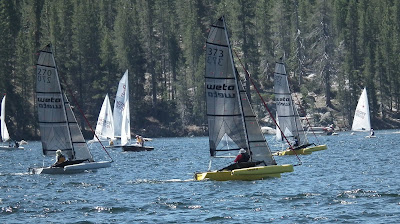
Well, for 2011 it was Weta time, and we had a truly amazing turnout, 15 signed up, for the class' debut on Huntington Lake. A trimaran is an odd boat, and I was uncertain if we'd be able to apply the "classic" approaches. Would the windshifts be worth chasing in a relatively slow tacking boat? Would it be possible to stay in pressure downwind while sailing hot angles?
 My compass told me that each shift was typically 15 to 20 degrees with some as large as 40! Catching the right side of those while staying in pressure is a huge advantage. I managed to do that most of the time upwind, but downwind I was mostly just flailing about hoping to get lucky. Race 2 was the only one I managed to get it a little figured out. Finding some big fat port tack headers down the North side of the lake allowed me to make some big gains after my very late start. In dead down wind boats like the Megabyte and Vanguard 15, the Huntington Lake downwind tactics are relatively simple--keep the boat pointed at the leeward mark and slide left or right to stay in pressure, gybing as needed depending on how significant the shift is. The Weta, on the other hand, needs to be kept hot downwind with gybing angles near 90 degrees. I guess that makes the downwind tactics about the opposite of the upwind tactics, and I just couldn't figure out how to sail fast and think backwards at the same time.
Frustrating or exhilarating on the water, Huntington has always been a blast on the beach, around the campsites, and all. This year was no exception with big Weta turnout--most with full families joining in the fun (both on and off the water.) So, what'll it be next year? Great, of course, but which boat? I really need another crack at learning the lake downwind Weta style, but Dean and I also chatted up the possibility of borrowing his dad's Lido 14 to have a try in that class--perennially, one of the biggest at the regatta. Whichever, it'll be great. The only problem will be trying to fit so many class party appearances into a short weekend. Hmmm, Wetas for cocktails, ex-Megabytes (Folsom Lake crowd) for Mexican potluck, Lidos for dessert, and a nightcap with the Vanguards at Catavee.

The boats will come and go, carrying us upwind and down. The friendships will be treasured, filling us with good feelings from year to year.

OK, that's not really true. Thankfully the "whom" is always there for all the great camaraderie ashore no matter what classes they're sailing alake. But, out on the water it is all about solving the wind over water puzzle that gets the boat up and down the lake faster than anybody else. Sure, everybody has read the "primer" that's been posted on the regatta website for years. My first year sailing the lake (as an adult anyway) I was surprised that Charles Witcher, who as far as I knew had never lost even a single race on this lake, would willingly share all of his secrets. I read that sheet over and over for several days prior to the regatta. Charles would be sailing in the same class as me, Megabytes, and his fellow lake guru, Craig Lee, had borrowed a boat to join in the fun. Well, the study didn't help as those two guys left me so far behind that I could hardly see them. It was very frustrating as I seemed to be doing everything wrong.
The next year, back in the Megabyte chasing Charles, I decided to not try to be so smart and instead just sail conservatively and easy. Low and behold, I started to recognize some patterns first hand, "feeling" the lake in a sort of Tarzan, maybe George 'o Jungle, swinging kind of way. I still got my butt kicked, but at least I was close enough to see the butt on the guy who was doing it to me. Bu year three, I was Megabyteless and jumped in to crew for Dean on the Vanguard. Maybe it was the two years of dues paying experience or maybe it was the observer friendly vantage point from the crew spot, but I really started to feel good on the lake for the first time. More than half the time, we were in sync with the advantages. The racing was outstanding at the front, the best I'd ever been involved in. The lake felt fun for the first time.
Well, for 2011 it was Weta time, and we had a truly amazing turnout, 15 signed up, for the class' debut on Huntington Lake. A trimaran is an odd boat, and I was uncertain if we'd be able to apply the "classic" approaches. Would the windshifts be worth chasing in a relatively slow tacking boat? Would it be possible to stay in pressure downwind while sailing hot angles?
 My compass told me that each shift was typically 15 to 20 degrees with some as large as 40! Catching the right side of those while staying in pressure is a huge advantage. I managed to do that most of the time upwind, but downwind I was mostly just flailing about hoping to get lucky. Race 2 was the only one I managed to get it a little figured out. Finding some big fat port tack headers down the North side of the lake allowed me to make some big gains after my very late start. In dead down wind boats like the Megabyte and Vanguard 15, the Huntington Lake downwind tactics are relatively simple--keep the boat pointed at the leeward mark and slide left or right to stay in pressure, gybing as needed depending on how significant the shift is. The Weta, on the other hand, needs to be kept hot downwind with gybing angles near 90 degrees. I guess that makes the downwind tactics about the opposite of the upwind tactics, and I just couldn't figure out how to sail fast and think backwards at the same time.
Frustrating or exhilarating on the water, Huntington has always been a blast on the beach, around the campsites, and all. This year was no exception with big Weta turnout--most with full families joining in the fun (both on and off the water.) So, what'll it be next year? Great, of course, but which boat? I really need another crack at learning the lake downwind Weta style, but Dean and I also chatted up the possibility of borrowing his dad's Lido 14 to have a try in that class--perennially, one of the biggest at the regatta. Whichever, it'll be great. The only problem will be trying to fit so many class party appearances into a short weekend. Hmmm, Wetas for cocktails, ex-Megabytes (Folsom Lake crowd) for Mexican potluck, Lidos for dessert, and a nightcap with the Vanguards at Catavee.

The boats will come and go, carrying us upwind and down. The friendships will be treasured, filling us with good feelings from year to year.
05 July 2011
Dear Kara
Thanks for going sailing with your dad and me on the Weta last Saturday. The sun was warm, the wind wash fresh, and you were great crew. I'm glad you didn't mind getting wet, soaked really. Once your dad started driving, it was pretty much impossible to get him to slow down--too much fun!
After the sailing, I hope your kayak practice went well--that'll be a good skill for Huntington Lake. I know my tacking practice will pay off. It seemed the one hand for the tiller, one for the sheets, cross behind the back technique was fastest (at least in the protected marina conditions.) Let's compare notes this weekend.
See you soon,
Mr. Anderson.
After the sailing, I hope your kayak practice went well--that'll be a good skill for Huntington Lake. I know my tacking practice will pay off. It seemed the one hand for the tiller, one for the sheets, cross behind the back technique was fastest (at least in the protected marina conditions.) Let's compare notes this weekend.
See you soon,
Mr. Anderson.
02 July 2011
Shortcoursing Monoslugs
From battling twelve fourteen-foot trimarans up a mile and a half beat for two days on the open bay to bangin' out eight college-style shortcourse races in a couple-a-hours against seven fifteen-foot Vanguards, it's been a great week of sailing. It's July already, and I only just got out with Fleet 76 for the first time this season, and last night was perfect--relatively flat water despite the building ebb, steady 20 knot breeze, and warm summer temps. Chris and crew did a fantastic job with the race committee, keeping us hot lapping and mixing up the courses for interest. Lots of yelling and screaming at the starting line as skippers struggled to remember the approach (and rules) when starting with a strong current doing its best to shove everybody over early. Good fun. Note to self: get out there with them more often.
High Sierra Regatta at Huntington Lake up next. Fleet 76 will be there with another strong showing for the Vanguard 15 class, and the Wetas will have 14 on the line in just our fist ever trip to Huntington. It'll be a good mix of NorCal and SoCal duking it our for West Coast supremacy.
High Sierra Regatta at Huntington Lake up next. Fleet 76 will be there with another strong showing for the Vanguard 15 class, and the Wetas will have 14 on the line in just our fist ever trip to Huntington. It'll be a good mix of NorCal and SoCal duking it our for West Coast supremacy.
Subscribe to:
Posts (Atom)